Unless – A Homily for Corpus Christi

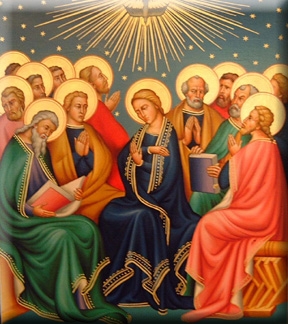
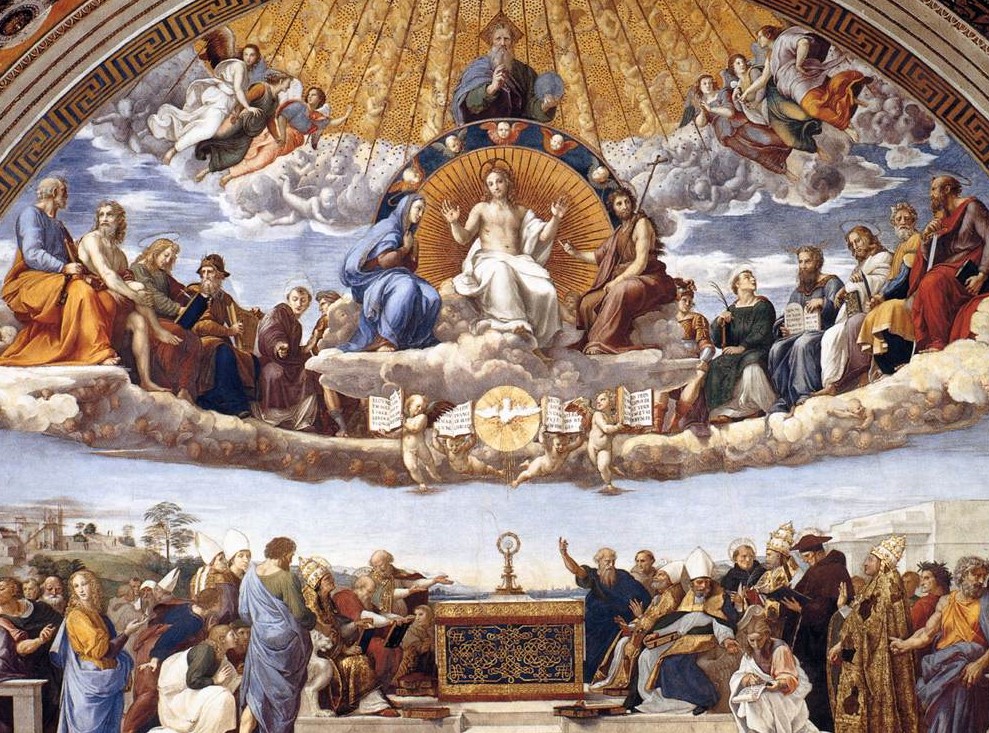
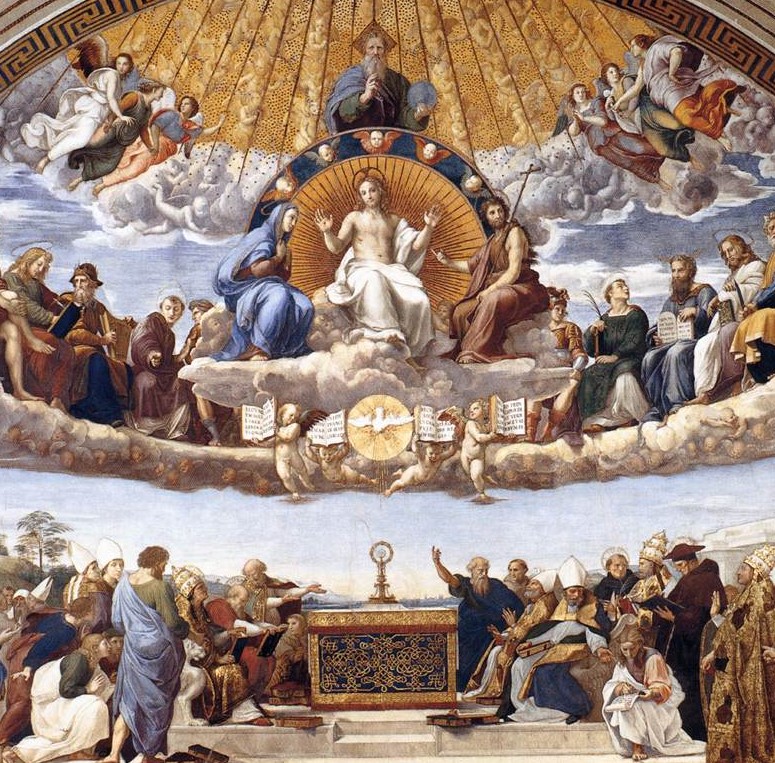
Disputation of the Holy Sacrament, Raphael (1510-11)

I.  The Reality of the Eucharist

On this solemn feast we are called above all to faith in the fact (as revealed by the Lord Himself) that the Eucharist, the Holy Communion of which we partake, is in fact a reception of the very Body, Blood, Soul, and Divinity of Jesus Christ, whole and entire, in His glorified state.

We do not partake of a symbol; the Eucharist is truly the Lord. Neither is it a “piece” of His flesh; it is Christ, whole and entire. Scripture attests to this in many places.

And he took bread, and when he had given thanks he broke it and gave it to them, saying, “This is my body which is given for you. Do this in remembrance of me.” And likewise the cup after supper, saying, “This cup which is poured out for you is the new covenant in my blood” (Luke 22:19-20).

The cup of blessing which we bless, is it not a partaking in the blood of Christ? The bread which we break, is it not a partaking in the body of Christ? (1 Cor 10:16).

They recognized him in the breaking of the bread. (Luke 24:35).

For anyone who eats and drinks without recognizing the body of the Lord eats and drinks judgment on himself. (1 Cor 11:29).

I am the living bread which came down from heaven; if any one eats of this bread, he will live for ever; and the bread which I shall give for the life of the world is my flesh. (John 6:51).

This last passage is a profound theology of the Eucharist from Jesus Himself. He makes it clear that we are not to think of the Eucharist as symbolic.

As Jesus spoke the words saying that the bread was His flesh, the Jewish people grumbled in protest. Jesus did not seek to reassure them or to say that He was speaking only symbolically. Rather, He became even more adamant, shifting His choice of words from the polite form of eating, φάγητε (phagete, meaning to eat), to the impolite form, τρώγων (trogon, meaning to munch, gnaw, or chew).

So insistent was He that they grasp this, that He permitted most of them to leave, no longer following in His company due to this teaching (cf Jn 6:66). Yes, the Lord paid quite a price for His graphic and “hard” teaching (Jn 6:60).

Today, He asks us, Do you also want to leave me? (Jn 6:67) We must give our answer each time we approach the altar and hear the words, “The Body of Christ.” It is at this time that we respond, “Amen,” as if to say, “Lord, to whom shall we go? You have the words of eternal life” (Jn 6:68).

Would that people grasped that the Lord Himself is truly present in our Churches! Were that so, one would never be able to empty our parishes of those seeking to pray with the Lord. As it is, though, only about 25% of Catholics attend Mass regularly. This is more evidence of the “narrow road” and of how few there are who find it. Two thousand years ago, Jesus experienced that most left Him; many today continue to leave Him (or stand far away), either through indifference or false notions.

What father would not be alarmed if one of his children stopped eating? Consider, then, God’s alarm that many of us have stopped eating.

II.  The Requirement for the Eucharist

This is where the “Unless” in the title of this post comes in. When I was young I thought of Mass and Communion as just something my mother made me do; it was just a bunch of rituals to me. I never thought of it as essential for my survival. Jesus teaches something very profound in John’s Gospel today. In effect, He says that without Holy Communion, the Eucharist, we will starve and die spiritually.

Here is what Jesus says: Unless you eat the flesh of the Son of Man and drink his blood, you have no life in you (John 6:53).

As a child and even as a young adult I never thought of Holy Communion as essential for my life, as something that, if not received regularly, would cause me to die spiritually. It makes sense, though, doesn’t it? If we don’t eat food in our physical life, we would grow weak and eventually die. It is the same with Holy Communion with respect to our spiritual life.

Remember in the Book of Exodus that the people in the desert were without food and feared for their lives. In response, God gave them bread from Heaven called “manna,” which they collected each morning. Without eating that bread from Heaven, they would never have made it to the Promised Land; they would have perished in the desert.

It is the same with us. Without receiving Jesus, our Living Manna from Heaven, in Holy Communion, we will not make it to our Promised Land of Heaven. It is not just a ritual; it is essential for our survival.

Don’t miss Holy Communion! Jesus urges you to eat. A number of years ago, a mother and father in my parish noticed that their daughter wasn’t eating. They wasted no time in taking her to a doctor, who diagnosed the problem and prescribed the remedy. Those parents would have moved Heaven and Earth to get their daughter eating again! It is the same for God. Jesus urges us to eat, to receive Holy Communion every Sunday. Jesus urges us with this word: “Unless.” Holy Communion is our required food.

III.  The Reverence for the Eucharist

One of the common, mistaken notions about the Eucharist is confusing this sacred meal with the table fellowship Jesus had with sinners. He was known to “welcome sinners and eat with them.” Holy Mass, however, is not one of those sorts of meals. The Last Supper, at which the essential reality of the Mass was first set forth, was held in the context of the Passover. Passover was a sacred meal shared within the family. Therefore, Jesus celebrated that Last Supper with the twelve Apostles.

This lack of understanding of the difference between the sacred meal of the Eucharist and common table fellowship leads many to misconstrue the Eucharist; it also helps to explain the Church’s stance.

Those who think of the Mass as the mere table fellowship Jesus had with sinners tend to interpret the Eucharist as a “Come one, come all” sort of meal. Many also add, “Come as you are.” In their view, there are no requirements; all that matters is that Jesus is offering. “Don’t worry,” they say, “about ‘membership’ or the need to be reconciled from sin. After all, Jesus ate with sinners and He didn’t worry about those things.”

Again, however, this is not what the Last Supper was. Jesus celebrated the Mass in the context of the Passover. Such meals presupposed that the people gathered together were family. This was an intimate meal celebrated in the context of faith, however weak or strong, but a faith that was presupposed. Jesus said to them, You are the men who have stood by me in my trials (Lk 22:28).

This is one reason that the Church has always limited the reception of the Eucharist to those who are initiated, who are “members of Christ’s Body” through faith, and who keep communion with His Body the Church through assent to her teachings, remaining members of His Body by being in a state of grace.

It further explains the need to receive the Eucharist worthily by first confessing serious sins through the Sacrament of Confession. St. Paul teaches,

Let a person examine himself, then, and so eat of the bread and drink of the cup. For anyone who eats and drinks without discerning the body eats and drinks judgment on himself. That is why many of you are weak and ill, and some have died (1 Cor 11:28-30).

Here, too, we see that the Mass is not akin to the table fellowship that Jesus at times kept with sinners. Rather, it is a sacred meal that presupposes membership in Christ’s Body through faith and the forgiveness of all serious sins that might have severed that communion. Holy Communion is meant to strengthen a communion that already exists. Thus, our “Amen” before receiving Holy Communion is not a lie, but is consonant with the reality of existing communion.

I will write more on this topic in the coming week, but for now simply note that our reverence for Holy Communion requires us to receive worthily, in a state of grace that has preserved the communion we celebrate. Further, to receive worthily also requires that we have the faith of the Church, the Body of Christ, and keep communion by a belief in conformity and communion with it.

On this Solemnity of the Body of Christ we are summoned to deepen our faith in the Lord, present in the Eucharist and acting through His Sacraments. Routine may have somewhat of a dulling effect, but it cannot be so much so that we receive the Lord of glory in any way that could be called mindless or lacking in the reverence we ought to have for Him.

Ask the Lord to anoint your mind so that you never forget your need for the Eucharist. Unless! Unless you eat the flesh of the Son of Man and drink His Blood, you have no life in you (cf Jn 6:53). However, receive this great gift worthily and with a communion that befits the Holy Communion to which we are summoned.
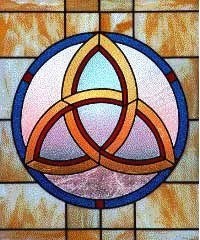
Why Does Jesus Say That the Father Is Greater Than He If the Members of the Trinity Are Equal?

A common question arising around the time of Trinity Sunday is rooted in this passage from John’s Gospel:

If you loved me, you would be glad that I am going to the Father, for the Father is greater than I (Jn 14:28).

This is somewhat puzzling because we are taught that each Divine Person of the Blessed Trinity fully possesses the nature of God and is equally to be adored and glorified. What, then, did Jesus mean when He said, “the Father is greater than I”?

The most common (and correct) answer is that in this passage Jesus was speaking in reference to His human nature, in which He is inferior to the Father; in His divine nature He is equal to the Father. Many of the Church Fathers spoke in this way. For example,

    • St Augustine said, Let us acknowledge then the twofold substance of Christ, the divine, which is equal to the Father, and the human, which is inferior. But Christ is both together, not two, but one Christ: else the Godhead is a quaternity, not a Trinity. Wherefore He says, If ye loved Me, ye would rejoice, because I said, I go to the Father; for human nature should exult at being thus taken up by the Only Begotten Word, and made immortal in heaven; at earth being raised to heaven, and dust sitting incorruptible at the right hand of the Father. Who, that loves Christ, will not rejoice at this, seeing, as he doth, his own nature immortal in Christ, and hoping that He Himself will be so by Christ (Quoted in the Catena Aurea at John 14:28).
    • Didymus the Blind said, When he says “greater” he indicates that his divinity can be equaled to the Father, since he is of the same substance as him, but the Father is greater because the Son accepted a body…The Son’s nature is understood to be less than that of the Father inasmuch as the Son became man (Fragments on John at 14).
    • Hilary of Poitiers said, By the birth of the Son the Father is constituted greater … in that the Son, born of the Father, after assuming an earthly body, is taken back to the glory of the Father (On the Trinity, 9:56).
    • Theodoret of Cyr had Jesus speak, saying, Sometimes therefore I, [Jesus] say that I am equal to the Father, and at other times say that the Father is greater than I. I am not contradicting myself, but I am showing that I am God and a human being … If you want to know how the Father is greater than I, I was talking from the flesh, not from the person of the Divinity (Dialogue 1:56).

Thus, the first answer is clear: As God, Jesus is equal to the Father, but as Man, He is inferior to the Father.

In a qualified way, however, it is also possible to speak of a particular greatness of the Father even within the Trinity. While all three persons of the Trinity are co-eternal, co-equal, and equally divine, the Father is the Principium Deitatis (the Source in the Deity). So, although the members of the Trinity are all equal in dignity, there are processions in the Trinity. The Father is the Principium, the Son eternally proceeds from Him and is eternally begotten by Him (Jn 8:42); the Holy Spirit eternally proceeds from the Father and the Son as from one principal (Jn 15:26).

Thus, even from the perspective of His divinity it is possible for Jesus to say, “I delight that the Father is the eternal principal of my being. Even though I have no origin in time, I do eternally proceed from Him.”

The Athanasian Creed says the following regarding these processions:

The Father is made by none, neither created nor begotten.
The Son is of the Father alone, neither made nor created, but begotten.
The Holy Spirit is of the Father and of the Son, not made, nor created, nor begotten, but he proceeds from them.

St. Thomas Aquinas speaks poetically of the Trinity in the familiar hymn “Tantum Ergo”:

Genitori, Genitoque … Procedenti ab utroque … compar sit laudautio.
(To the One Who Begets, and to the Begotten One, and to the One who proceeds from them both, be equal praise.)

So, although the Persons of the Trinity are equal, the processions within the Trinity do have an order. The Father is “greater” in the very qualified sense that He is the Principium Deitatis, the Principal of the Deity, but is co-eternal and equal in dignity to the Son and the Holy Spirit.

Devotionally, Jesus may also be speaking of the Father as greater in the sense that He always does what pleases His Father. Jesus loves His Father; He’s crazy about Him. He is always talking about Him and pointing to Him. By calling the Father “greater,” Jesus says (in effect), “I look to my Father for everything. I do what I see Him doing (Jn 5:19) and what I know pleases Him (Jn 5:30). As God, we share one will; as human, my human will and His will are one. What I will to do proceeds from Him. I do what I know accords with His will.”

Love on the Move: Of the Divine “Dance” In the Holy Trinity

There is a kind of tension in some of the imagery we use for God. On the one hand we call Him the “Unmoved Mover.” We also say that God is everywhere. If He is everywhere then there is nowhere for him to go, no need for Him to move because He is already there. Yet we also speak of “processions” in the Trinity.

St. Thomas artfully and with precision speaks of the Trinity and the two “processions” as Gentori Genitoque laus et jubilatio … Procedenti abutroque compar sit laudatio (To the One who generates and to the One who is generated be praise and jubilation … To the One proceeding from them both be equal praise).

St. Thomas also points out an important difference between material procession and divine procession:

In material things, what comes forth from another is no longer in it, since it comes from it by a separation from it in essence or in space. But in God, coming forth does not arise in this way. The Son came forth eternally from the Father in such a way that the Son is still in the Father from all eternity. And so, when he is in the Father, he comes forth. And when he comes forth, he is in him, in such a way that he is always coming forth, and always in him (Commentary on John, 16:28).

So, it would seem that the Unmoved Mover, our Triune God, has processions of love within. There is a kind of dynamism of love! Of course, our feeble words fall short and our analogies are weak.

There is a beautiful Greek word used by the Church Fathers (e.g., St. John Damascene) to describe the inner life of the Trinity: perichoresis. It is a combination of two words: peri, meaning “around” and chorein, meaning “to make space.” Therefore perichoresis, literally translated, means “to make space around.” It points to the way in which someone or something makes space around itself for others or for something else.

What a picturesque word! It suggests a kind of swirling or a dance. It is close in its spelling to the Greek word for dance, choreuo, so many people refer to it as the dance of love in the Trinity. Father, Son, and Holy Spirit make room for one another; they “dance” about and “with” one another in a way that shows a mutual indwelling while still maintaining space for each person.

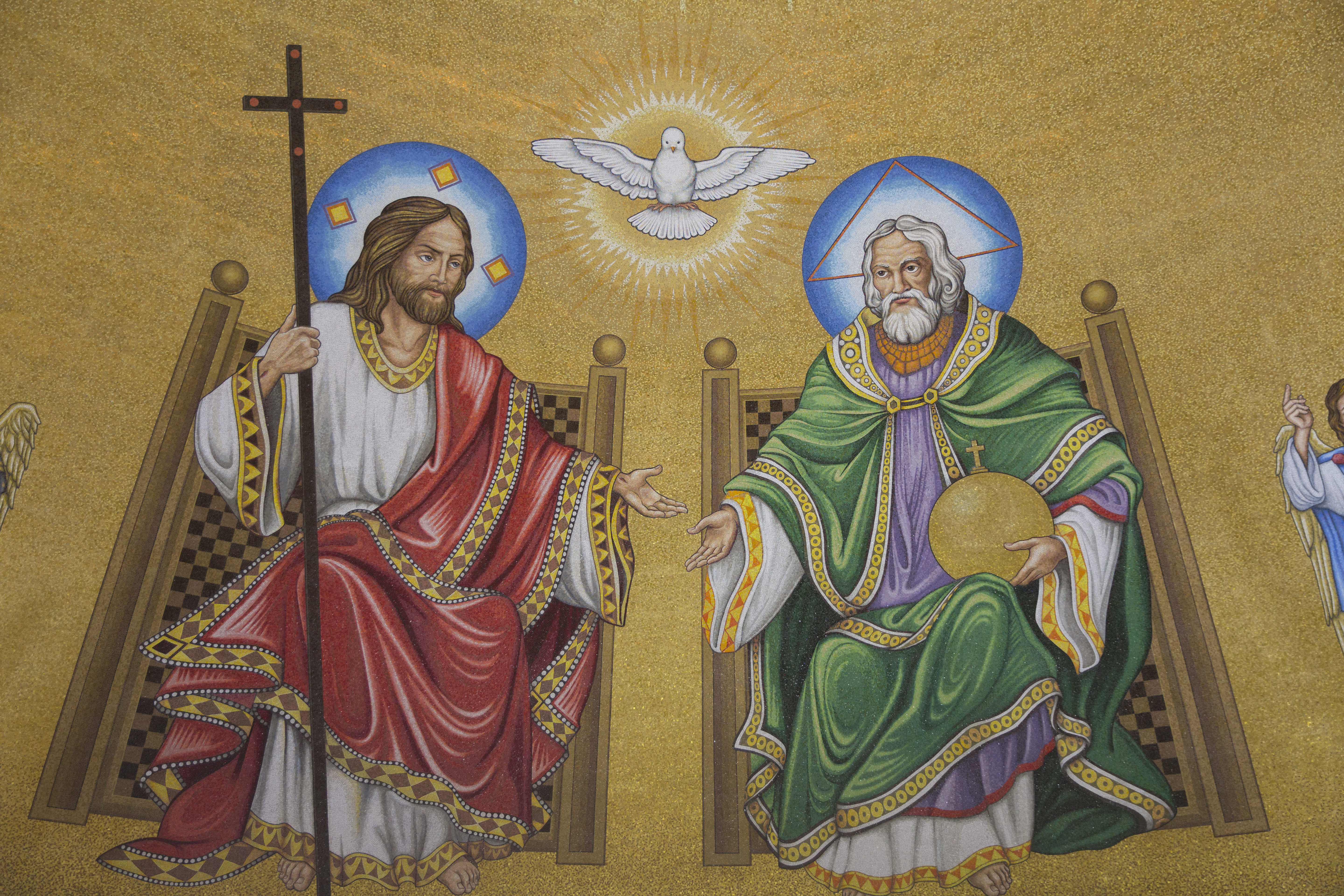
Yes, love is dynamic. There is a movement of love between the persons of the Trinity. This imagery is powerfully different than the one that most people have of the Trinity (God the Father on one throne, sitting next to His Son on another, with the Holy Spirit hovering like a dove between them). This is not wrong. Scripture speaks of thrones in Heaven and of the Father and the Son seated, but the thrones are likely more an image of authority than of inactivity.

Surely the inner life of the Trinity is more than merely being seated. It is a glorious procession of love: The Father loves the Son, the Son loves the Father, and the Holy Spirit is the love proceeding from them both. Yes, there is a great movement, a dance of love.

To this “dance” of love, Christ draws His Bride, the Church. It is our destiny and dignity to be caught up one day to the great dance of love of the Trinity. Heaven is not a static vision of God from some distance; it is a beatific vision, an experience of love that is dynamic and moving, a dance of ecstasy.

Put on your dancing shoes and get ready for the dance! Remember that to dance well we must surrender all pride and learn to dance as if no one is watching. Only the humble can really dance well, only those who can make space for the Lord and let Him lead.

I hope you will forgive the secular source, but below is an image of Christ drawing His bride to the dance.

I Have Come to Cast A Fire on the Earth – A Homily for Pentecost Sunday

What a wondrous and challenging feast we celebrate at Pentecost! A feast like this challenges us because it puts to the lie a lazy, sleepy, hidden, and tepid Christian life. The Lord Jesus said to the apostles, I have come to cast a fire on the earth (Luke 12:49). This is a feast about fire, a transformative, refining, purifying fire that the Lord wants to kindle in us. It is a necessary fire, for as the Lord first judged the world by fire, the present heavens and the earth are reserved for fire. Because it is going to be the fire next time, we need the tongues of Pentecost fire to fall on us to set us on fire and bring us up to the temperature of glory.

The readings today speak to us of the Holy Spirit in three ways: the portraits of the Spirit, the proclamation of the Spirit, and the propagation by the Spirit.

I. The Portraits of the Spirit – The reading today speaks of the Holy Spirit using two images: rushing wind and tongues of fire. These two images recall Psalm 50, which says, Our God comes, he does not keep silence, before him is a devouring fire, round about him a mighty tempest.

Rushing Wind – Notice how the text from Acts opens: When the time for Pentecost was fulfilled, they were all in one place together. And suddenly there came from the sky a noise like a strong driving wind, and it filled the entire house in which they were.

This text brings us to the very root meaning of the word “spirit.” Spirit refers to breath. This is preserved in the word “respiration,” which is the act of breathing. So, the Spirit of God is the breath of God, the Ruah Adonai (the Spirit, the breath of God).

Genesis 1:2 speaks of this, saying, the Spirit of God was moving over the face of the waters. Genesis 2:7 speaks even more remarkably of something God did only for man (not the animals): then the LORD God formed man of dust from the ground and breathed into his nostrils the breath of life; and man became a living soul.

So, the very Spirit of God was breathed into Adam, but he lost this gift and died spiritually when he sinned.

Thus, we see in this passage from Acts an amazing and wonderful resuscitation of the human person as these first Christians experience the rushing wind of God’s Spirit breathing spiritual life back into them. God does C.P.R. and brings humanity, dead in sin, back to life! The Holy Spirit comes to dwell in us once again as in a temple (cf 1 Cor 3:16). It has been said that Christmas is the feast of God with us, Good Friday is the Feast of God for us, but Pentecost is the Feast of God in us.

Tongues of Fire – The text from Acts then says, Then there appeared to them tongues as of fire, which parted and came to rest on each one of them.

The Bible often speaks of God as fire or in fiery terms: Moses saw Him as a burning bush. God led the people out of Egypt through the desert as a pillar of fire. Moses went up onto a fiery Mt. Sinai where God was. Psalm 97 says,

The LORD reigns; let the earth rejoice; let the many coastlands be glad! Clouds and thick darkness are round about him; righteousness and justice are the foundation of his throne. Fire goes before him, and burns up his adversaries round about. His lightnings lighten the world; the earth sees and trembles. The mountains melt like wax before the LORD, before the Lord of all the earth. The heavens proclaim his righteousness; and all the peoples behold his glory (Psalm 97).

Scriptures also call God a Holy fire, a consuming fire (cf Heb 12:29) and a refining fire (cf Is. 48:10; Jer 9:7; Zec 13:9; Mal 3:3).

So it is that our God, who is a Holy Fire, comes to dwell in us through His Holy Spirit. As a Holy Fire, He refines us by burning away our sins and purifying us. As Job once said, But he knows the way that I take; when he has tested me, I will come forth as gold (Job 23:10).

God is also preparing us for judgment, for if He is a Holy Fire, then who may endure the day of His coming or of going to Him? What can endure the presence of Fire Himself? Only that which is already fire. Thus, we must be set afire by God’s love.

So, in the coming of the Holy Spirit, God sets us on fire to make us a kind of fire. In so doing, He purifies us and prepares us to meet Him one day, to meet Him who is a Holy Fire.

II. The Proclamation of the Spirit – You will notice that the Spirit came on them like “tongues” of fire. The reference to tongues is no accident, for the Holy Spirit moves them to speak and ultimately to witness. The text says, And they were all filled with the Holy Spirit and began to speak in different tongues, as the Spirit enabled them to proclaim. Now there were devout Jews from every nation under heaven staying in Jerusalem. At this sound, they gathered in a large crowd, but they were confused because each one heard them speaking in his own language. They were astounded, and in amazement they asked, “Are not all these people who are speaking Galileans? Then how does each of us hear them in his native language? We are Parthians, Medes, and Elamites, inhabitants of Mesopotamia, Judea and Cappadocia, Pontus and Asia, Phrygia and Pamphylia, Egypt and the districts of Libya near Cyrene, as well as travelers from Rome, both Jews and converts to Judaism, Cretans and Arabs, yet we hear them speaking in our own tongues of the mighty acts of God.”

So, behold how the Holy Spirit moves them to proclaim, not just within the safety of the upper room, but also in holy boldness before the crowds that have gathered.

Notice the transformation! Moments ago, these were frightened men huddled together in secrecy behind locked doors. Now, they go forth to the crowds and proclaim Christ boldly. They have gone from fear to faith, from cowardice to courage, from terror to testimony!

What about us? Too many Christians are silent, overcome by fear. Perhaps they fear being called names or being unpopular. Perhaps they are anxious about being laughed at or resisted, or of being asked questions they don’t feel capable of answering. Some Christians gather in the “upper room” of the parish and are active—even leaders—but once outside the safe confines of the “upper room” they slip into what I call “secret agent” mode.

Well, the Holy Spirit wants to change that. To the degree that we have really met Jesus Christ and experienced His Holy Spirit, we are less able to keep silent. An old gospel song says, “I thought I wasn’t gonna testify, but I couldn’t keep it to myself, what the Lord has done for me.” The Holy Spirit, if authentically received, wants to give us zeal and joy, to burn away our fear so that testifying and witnessing come naturally to us.

Note also how the Spirit “translates” for the Apostles. The people in the crowd spoke different languages, yet each heard Peter and the others in his own language. The Spirit, therefore, assists not only us but also those who hear us. My testimony is not dependent on my eloquence alone but also on the grace of the Holy Spirit, who casts out deafness and opens hearts. Every Christian should remember this. Some of our most doubt-filled encounters with others can still bear great fruit on account of the work of the Holy Spirit, who “translates” for us and overcomes obstacles we might think insurmountable.

III. The Propagation by the Spirit – In the great commission, the Lord said, Go, therefore, and make disciples of all nations, baptizing them in the name of the Father, and of the Son, and of the Holy Spirit, teaching them to observe all that I have commanded you. And behold, I am with you always, until the end of the age (Matt 28:19ff). He also said, I have come to cast a fire on the earth and How I wish the blaze were already ignited (Luke 12:49).

How is the Lord going to do this?

Perhaps a picture will help to illustrate. My parish church is dedicated to the Holy Spirit under the title “Holy Comforter.” Above the high altar is the following Latin inscription: Spiritus Domini, replevit orbem terrarum (The Spirit of the Lord, filled the orb of the earth). (See the photo above of our high altar.)

The walls of my parish church answer the question. The clerestory walls are painted Spanish red, and upon this great canvas are also painted the stories of the lives of twenty saints, surrounding us like a great cloud of witnesses (cf Heb 12:1). (See also the video below.) Over the head of every saint is a tongue of fire.

This is how the Spirit of the Lord fills the earth. It is not via “magic fairy dust.” It is in the fiery transformation of every Christian going forth to bring warmth and light to a cold, dark world. This is how the Lord casts fire upon the earth. This is how the Spirit of the Lord fills the orb of the earth—in the lives of saints (and in your life)!

In the end, the great commission (Matt 28) is our first and most important job. No matter what else we do, we are to do this. Parishes do not deserve to exist if they do not do this. As individual Christians, we are a disgrace and not worthy of the name if we fail to win souls for Jesus Christ. The Spirit of the Lord is going to fill the orb of the earth but only through us. The spread of the gospel has been placed in your hands. It’s scary, isn’t it!

In my short time on this planet, I have seen it. Parishes that were once big and booming (and, frankly, sometimes arrogant) are now in decline; some are near closure. It happens to the best if they do not evangelize, if they do not accomplish “job one.” The Lord wants to light a fire. Why not become fire? Let the Spirit propagate the Church through you. (Yes, I am talking to you.)

Enjoy the feast of Pentecost, but don’t forget that the basic image is very challenging, for it means getting out of the “upper room,” opening the doors, and proclaiming Christ to the world. Let the Holy Spirit light a fire in you. Then you can’t help but spread light and heat to a dark, cold world.

Let the evangelization of the whole world begin with you.

The video below features details from the clerestory of my parish, Holy Comforter in Washington, D.C. Notice the tongue of fire above each saint. The paintings show how the Spirit of the Lord fills the orb of the earth through the lives of the saints (and through you, too). It is not magic; it is grace, working in your life, through your gifts and your relationships, so that the Lord will reach each soul. The witnesses on the walls of my Church say, “You are the way that He will fill the earth and set it on fire.” Let the blaze be ignited in you!

The song accompanying the video says, “We are surrounded by a great cloud of witnesses, looking on, encouraging us to do the will of the Lord. Let us stand worthy and be faithful to God’s call … We must not grow weary …!”


The Role and Experience of the Angels at the Ascension

The Feast of the Ascension is often neglected today. It is tucked into a nearby Sunday, it’s role as the fortieth day, jettisoned. But even in those places that still honor it with a Thursday Solemnity, there is still a difficulty in appreciating the full glory of that day. In this post, following the Scriptures and the teaching of some of the ancient Fathers of the Church, we can investigate some of the more hidden glory of this magnificent event.

The fundamental source for these reflections is Jean Cardinal Danielou’s book The Angels and Their Mission: According to the Fathers of the Church. The references to the Fathers in this post are fully footnoted in his book, but some of the scriptural passages below represent my own additions.

We can begin with a parabolic prelude – Jesus told at least two parables that the Fathers of the Church interpret to represent the angels:

    • Then Jesus told them this parable: “What man among you, if he has a hundred sheep and loses one of them, does not leave the ninety-nine in the pasture and go after the one that is lost, until he finds it? And when he finds it, he joyfully puts it on his shoulders, comes home, and calls together his friends and neighbors to tell them, ‘Rejoice with me, for I have found my lost sheep!’ In the same way, I tell you that there will be more joy in heaven over one sinner who repents than over ninety-nine righteous ones who do not need to repent. (Luke 15:3-7)
    • Or what woman who has ten silver coins and loses one of them does not light a lamp, sweep her house, and search carefully until she finds it? And when she finds it, she calls together her friends and neighbors to say, ‘Rejoice with me, for I have found my lost coin.’ In the same way, I tell you, there is joy in the presence of God’s angels over one sinner who repents.” (Luke 15:8-10)

Gregory Nazianzus interprets this parable as Christ entering into heaven at the Ascension and, after having recovered the lost sheep and the Lost Drachma and calling together the angels to share his joy.

Indeed, there is a whole tradition, among the Fathers but going back much further into the early Church which sees the lost sheep as human beings, and flock which the Good Shepherd “leaves” in order to search for the sheep as the angels. Origen sets it forth and Methodius of Philippi writes: “We must see the ninety-nine sheep as a representation of the Powers, Principalities and Dominations whom the Head and Shepherd has left behind to go down and seek out the one lost sheep.”  Gregory of Nyssa adds: “We mankind, are the lost sheep…and have strayed from the other spiritual creates [i.e. the angels].

Hence we are given a picture of joy as Christ re-enters heaven with the lost sheep of humanity.

The Picture of the Ascension given by the Lord: Jesus prophecies his ascension in John’s Gospel as something which Nathaniel will see. The Lord’s description also shows the role of the angels

Jesus said to Nathaniel, “Do you believe just because I told you I saw you under the fig tree? You will see greater things than these.” Then He declared, “Truly, truly, I tell you, you will see heaven open and the angels of God ascending and descending on the Son of Man. (John 1:50-51)

Here then is a picture of Jesus ascending, not as a lone figure,

A picture from the Psalms: Church Fathers Eusebius, Chrysostom, Justin and Athanasius  say that  the virtues (i.e. angels) of heaven, seeing him begin to ascend, rise and surround him to form an escort proclaiming his ascension as they cried: Rise up eternal gates and the King of glory will enter!” Gregory of Nyssa adds, that at first the higher angels do not recognize Christ since he has put on the poor tunic of humanity and because his garments were stained with blood. And herein comes a questioning and wondering dialogue back and forth that is from Psalm 27 but which the ancient Fathers apply to the moment of the Ascension: 

The lower ranking angels who have escorted Jesus cry out to the higher ranking angles of heaven:

Lift up your heads, O gates! Be lifted up, O ancient doors, that the King of Glory may enter!

And from within the heavenly angels answer:

Who is this King of Glory?

And the escorting angels answer:

The LORD strong and mighty, the LORD mighty in battle. Lift up your heads, O gates! Be lifted up, O ancient doors, that the King of Glory may enter! (Psalm 24:7-9) 

Eusebius also cites Psalm 47 as fulfilled in the Ascension through the praises of the Angels: 

God ascends amid shouts of joy, the LORD with the sound of trumpets. Sing praises to God, sing praises; sing praises to our King, sing praises! For God is King of all the earth; sing profound praises to Him. God reigns over the nations; God is seated on His holy throne. For the shields of the earth belong to God; He is highly to be exalted. (Ps 47:5-9)

Another picture from Scripture (Isaiah 63:1-3) is applied by the Fathers to the Ascension where the angels of heaven, seeing Christ  approach, cry out:

Who is this coming from Edom, from Bozrah with crimson-stained garments? Who is this robed in splendor, marching in the greatness of His strength?

Jesus answers:

“It is I who speak in righteousness, mighty to save.”

The Angels ask:

Why are Your clothes red, and Your garments like one who treads the winepress?

Jesus answers:

“I have trodden the winepress alone, (Isaiah 63:1-3)

The exultation of our humanity In Christ’s Ascension is also a principle developed in Scripture and by the Father.  Thought the angelic nature remains superior to human nature in the order of creation, Christ’s incarnation, resurrection and ascension have exalted our humanity in his. The Book of Hebrews says,

[Jesus] has taken his seat at the right hand of the Majesty on high. So He became as far superior to the angels as the name He has inherited is excellent beyond theirs. For to which of the angels did God ever say: “You are My Son; today I have become Your Father” (Heb 1:3-4)

For it is not to angels that He has subjected the world to come, about which we are speaking. But somewhere it is testified in these words: “What is man that You are mindful of him, or the son of man that You care for him? You made him for a while lower than the angels; and now You have crowned him with glory and honor and placed everything under his feet. (Heb 2: 5-8)

These texts speak to Christ’s superiority to the Angels. As God, he was always superior to the angels but, in hypostatically uniting himself to a human nature, raising it gloriously and ascending with that glorified human nature, he has exalted us all.

St. John Chrysostom says of the Ascension: 

Today we are raised up into heaven, we who seemed unworthy even of  earth. [In Christ, and as members of his Body] We are exalted above the heavens; we arrive at the kingly throne. The [human] nature which caused the Cherubim to keep guard over paradise is seated today above the Cherubim. Was not such a glory beyond all expression? But he rose above the angels, he passed the cherubim, he went higher than the Seraphim, he bypassed the Thrones. He didn’t stop until He arrived at the very throne of God.

So, the Feast of the Ascension is our feast too. In baptism we died with Christ and rose with him to new life. In the Ascension of Christ, we also ascend. Hence, in Christ and as members of Christ’s Body through baptism, we are mystically seated with him at the Father’s right. In Christ and by his ascension our lowly nature is glorified and we hear the call “come up higher.” For now we never cease to honor the angels who by nature are superior to us and care for us. And yet, by grace alone and in Christ we have ascended with him to the highest place. On account of  which the angels marvel and sing God’s praises.

The Ascension is the counterpart of the fall in Eden, but we are not simply restored to an earthly paradise, we are taken to the heavenly one!

Is this why Satan rebelled? There is an ancient tradition that the angels where shown God’s plan and that Lucifer, a high ranking angel, recoiled at the idea of God joining himself to the mere “mud dolls” of humanity. Inspiring a rebellion he waged war in the heavens and was cast out by St. Michael and the other angels. Now he roams the earth, deeply envious of human beings and seeks to debase and destroy him. This is hinted at in Scripture in Revelation 12, but the details of the reason for Satan’s wrath are more in the realm of tradition and speculation. 

Here then are some reflections on the glorious feast of the Ascension from Scripture, and the teachings of the Fathers of the Church.

Lessons of Love – A Homily for the 6th Sunday of Easter

In the Gospel for today’s Mass, Jesus gives us three lessons on love meant to prepare us for the coming of the Holy Spirit at Pentecost. They also go a long way in describing the normal Christian life.

Too many Christians see the Faith more as a set of rules to keep than as a love that transforms—if we accept it. Let’s take a look at the revolutionary life of love and grace that the Lord is offering us in three stages: the power of love, the person of love, and the proof of love.

1.The Power of Love“If you love me, you will keep my commandments … Whoever has my commandments and observes them is the one who loves me.”

We must be very careful how we hear this, for it is possible to think that the Lord is saying, in effect, “If you love me, prove it by keeping my commandments.” This understanding reduces the Christian faith to a moral maxim: do good, avoid evil, and thus prove that you love God. Loving God, then, becomes a human achievement.

Understanding this text from the standpoint of grace, however, yields a different—and I would argue, more properunderstanding. Loving God is not a human work; it is the gift of God. The text should be read to say, in effect, “If you love me, then by this love I have given you, you will keep my commandments.” Thus, the keeping of the commandments is the fruit of the love, not the cause of it. Love comes first. When love is received and experienced, we begin, by the power of that love, to keep the commandments. Love is the power by which we keep the commandments.

It is possible to keep the commandments to some extent out of fear and by the power of the flesh, but obedience based on fear tends not to last and brings with it many resentments. Further, attempting to keep the commandments through our own power brings not only exhaustion and frustration, but also the prideful delusion that somehow we have placed God in our debt because we obey.

It is far better to keep the commandments by the grace of God’s love at work within us. Consider the following qualities of love:

A. Love is extravagant – The flesh is minimalist and asks, “Do I really have to do this?” Love, however, is extravagant and wants to do more than the minimum. Consider a young man who loves a young woman. It is unlikely that he would say, “Your birthday is coming soon and I must engage in the wearisome tradition of buying you a gift. So, what is the cheapest and quickest gift I can get you?” Of course he would not say this! Love does not ask questions like this. Love is extravagant; it goes beyond the minimal requirements and even lavishes gifts on the beloved, eagerly. Love has the power to overrule the selfishness of the flesh. No young man would say to his beloved, “What is the least amount of time I must spend with you?” Love doesn’t talk or think like this. Love wants to spend time with the beloved. Love has the power to transform our desires from our own selfish ends, toward the beloved.

While these examples might seem obvious, it is apparently not so obvious to many Christians, who say they love God but then ask such things as, “Do I have to go to church?” “Do I have to pray, and if so, how often and for how long? “Do I have to go to confession, and if so, how frequently? “What’s the least amount I can put in the collection plate or give to the poor in order to be in compliance?” Asking for guidelines may not be wrong, but too often the question amounts to a version of “What’s the least I can do?” or “What’s the bare minimum?”

Love is extravagant and excited to do and to give, to please the beloved. Love is its own answer, its own power.

B. Love Expands – When we really love someone we also learn to love whom and what he or she loves.

During high school, I dated a girl who liked square dancing. At first I thought it was hokey, but since she liked it, I started to like it. Over time, I even came to enjoy it a great deal. Love expanded my horizons.

I have lived, served, and loved in the Black community for most of my priesthood. In those years, I have come to love and respect gospel music and the spirituals. I have also come to respect and learn from the Black experience of spirituality, and have done extensive study on the history of the African-American experience. This is all because I love the people I serve. When you love people, you begin to love and appreciate what they do. Love expands our horizons.

What if we really begin to love God? The more His love takes root in us, the more we love the things and the people He loves. We begin to have God’s priorities. We start to love justice, mercy, chastity, and all the people He loves—even our enemies. Love expands our hearts.

The saints say, “If God wants it, I want it. If God doesn’t want it, I don’t want it.” Too many Christians say, “How come I can’t have it? It’s not so bad. Besides, everyone else is doing it.” Love does not speak this way.

As God’s love grows in us it has the power to change our hearts, minds, desires, and vision. The more we love God, the more we love His commands and share the vision He offers for our lives. Love expands our hearts and minds.

C. Love excites – Imagine again a young man who loves a young woman. Now suppose she asks him to drive her to work one day because her car is in the shop. He does this gladly and sees it as an opportunity to be with her and to help her. He is excited to do so and is glad that she asked. This is true even if he has to go miles out of his way. Love stirs us to fulfill the wishes and desires of the beloved.

In the first Letter of John we read, “For this is the love of God, that we keep his commandments. And his commandments are not burdensome” (1 John 5:3). Yes, love lightens every load. As we grow in love for God, we are excited to please Him. We keep His commandments, not because we have to, but because we want to. Even if His commandments involve significant changes, we do it with the same kind of gladness that fills a young man who drives miles out of his way to take his beloved to work. Love excites in us a desire to keep God’s law, to fulfill His wishes for us.

2.The Person of Love “And I will ask the Father, and he will give you another Advocate to be with you always, the Spirit of truth, whom the world cannot accept, because it neither sees nor knows him. But you know him, because he remains with you, and will be in you.”

In this text, Jesus tells us that the power to change us is not an impersonal power like “The Force” in Star Wars. Rather, what changes us is not a “what” at all but a “who.” The Third Person of the Blessed Trinity, living in us as in a temple, will change us and stir us to love. He who is Love will love God in us. Love is not our work; it is the work of God. “We love, because He first loved us” (1 John 4:10). God the Holy Spirit enables us to love God the Father and God the Son, and this love is the power in us that equips, empowers, and enables us to keep God’s law. He, the Holy Spirit, is the one who enables us to love extravagantly and in a way that expands and excites.

The Lord says that He, the Holy Spirit, remains in us. Are you aware of His presence? Too often our minds and hearts are dulled and distracted by the world and we are unaware of the power of love available to us. The Holy Spirit of Jesus and the Father is gentle and awaits the open doors we provide (cf Rev 3:20). As we open them, a power from His Person becomes more and more available to us and we see our lives being transformed. We keep the commandments; we become more loving, confident, joyful, chaste, forgiving, merciful, and holy. I am a witness! Are you?

3.The Proof of God’s Love“I will not leave you orphans; I will come to you. In a little while the world will no longer see me, but you will see me, because I live and you will live. On that day you will realize that I am in my Father and you are in me and I in you.”

The key phrases here are “You will live” and “You will realize,” for the Lord says that He will not leave us as orphans, that He will come to us and remain with us.

How do you know that these are more than just slogans? Simply put, you and I know this because of the new life we are receiving, which causes us to realize that Jesus lives, is in the Father, and is in us.

To “know” in the Bible is more than intellectual knowing. To “know” in the Bible is to “have intimate and personal experience of the thing or person known.” I know Jesus is alive and in me through His Holy Spirit because I am experiencing my life changing. I am seeing sins put to death and graces coming alive! I am a new creation in Christ (2 Cor 5:17). This is what Jesus means when He says, “You will realize that I am in the Father and in you.” To “realize” means to experience something as real.

I am proof of God’s love and its power to transform, my life is proof! In the laboratory of my own life I have tested God’s word and His promises, and I can report to you that they are true. I have come to experience as real (i.e., “realized”) that Jesus lives, that through His Holy Spirit I have a power available to me to keep the commandments and to embrace the new life, the new creation they both describe and offer to me.

I am a witness; are you?

This song says, “He changed my life and now I’m free …”


The Often-Disappointing Quality of the Prayer of the Faithful

One of the parts of the Ordinary Form of the Mass that was “restored” from antiquity is the Prayer of the Faithful. In my mind, however, there is a certain disappointing quality to the intentions as they are used today. They are either overly particular and ideological or, at the other end of the spectrum, perfunctory and flat. Peter Kwasniewski, in an article at New Liturgical Movement.org (here), summarizes the problem very well.

It is surely no exaggeration to say that throughout the world the quality of these intercessions has tended to be deplorable, ranging from trite and saccharine sentiments to political propaganda, from progressivist daydreams to downright heretical propositions to which no one could assent without offending God. Even when the content is doctrinally unobjectionable, all too often the literary style is dull, flaccid, rambling, or vague. … [There is] problematic content, poor writing, and [a] monotonous manner of delivery.

Additional problems occur when there are people of many different nationalities present and it is felt necessary to have the petitions read in multiple languages. The impression is given that the intentions are directed more to the congregation than to God, who knows all languages and thoughts. I have been at Mass in the Basilica here in Washington, D.C. when as many as nine different languages were used in the Prayer of the Faithful, despite the fact that the vast majority of those present spoke English and/or Spanish. I seriously doubt that there were more than five people in attendance who could speak only German, Mandarin, or one of the other languages used. It quickly gets very tedious as a line of people traipse back and forth to the microphone.

A final lament is that many of the suggested themes, (e.g. Church leaders, the deceased) are preayed for already in the Eucharistic Prayer of the Mass.

It is all so different in the Eastern Liturgies, in which the Great Litany is so artfully woven into the liturgical experience and beautifully sung as well. I have memorized the Great Litany from the Liturgy of St. John Chrysostom (see video below).

In his article (here), Mr. Kwasniewski offers a variety of intercessions, and download links are provided. I have done so for my own use and you might wish to do the same.

I would also like to add that St. Peter Canisius composed intercessions for use in his time. Saints are certainly reputable sources of such things! Here is an article by Mark Woodruff (with a tip of the hat to Rev. James Bradley) that details those prayers.

The point is that much can be done to improve the quality of the Prayer of the Faithful, which has remained an amateur outing at best and an ideological hornet’s nest at worst.

Perhaps some benefit can be obtained from reviewing the norms and the history of this portion of the Mass.

The General Instruction in the Roman Missal (GIRM) has this to say about the Prayer of the Faithful:

In the Prayer of the Faithful, the people respond in a certain way to the word of God which they have welcomed in faith and, exercising the office of their baptismal priesthood, offer prayers to God for the salvation of all. It is fitting that such a prayer be included, as a rule, in Masses celebrated with a congregation, so that petitions will be offered for the holy Church, for civil authorities, for those weighed down by various needs, for all men and women, and for the salvation of the whole world. As a rule, the series of intentions is to be

        1. For the needs of the Church;
          2. For public authorities and the salvation of the whole world;
          3. For those burdened by any kind of difficulty;
          4. For the local community.

Nevertheless, in a particular celebration, such as Confirmation, Marriage, or a Funeral, the series of intentions may reflect more closely the particular occasion.

It is for the priest celebrant to direct this prayer from the chair. He himself begins it with a brief introduction, by which he invites the faithful to pray, and likewise he concludes it with a prayer. The intentions announced should be sober, be composed freely but prudently, and be succinct, and they should express the prayer of the entire community (GIRM 69-71).

History – These intentions were very common in the early Church, occurring at about the same point in the Mass as today. They followed the Homily (note that in earlier days the Creed was typically not said). All of the Fathers of the Church make mention of them. In the beginning, this prayer was recited antiphonally by the priest and the assembly. Over time, the deacon assumed a more prominent role; he announced all the intentions and then the faithful responded with Kyrie eleison or some other acclamation. You can read the Kyrie Litany of Pope Gelasius here.

These intercessions endured until about the 9th century, well past the close of the patristic period. Their disappearance seems to coincide with their evolution into a Kyrie litany and their transfer to the beginning of the Mass. They eventually came to be regarded as an unnecessary appendage and were phased out. In the West they were used only on Good Friday, though they endured for longer in certain particular areas. In the East they were never dropped. Today they have been restored to their original place in the Mass.

Further pastoral reflections – One reason that they are called “general intercessions” is that they extend beyond the needs and concerns of the local assembly. Please note that they are not called the particular intercessions. What sometimes happens in more extemporaneous settings is that certain very specific needs are expressed; the list can become quite long. It is not appropriate here to pray, “for my Aunt Sue’s friend, who is recovering from hip surgery and having a hard time due to her diabetes.” It is more appropriate to pray, “for all who are sick or struggling in at this time.” The point is to keep it general; this is not the time for a full medical update on everyone’s relatives or friends.

Calling it the “Prayer of the Faithful” has some historical merit because catechumens and others were dismissed before the proclaiming of the intentions. Another reason it is also common to call them “general intercessions” is that the whole Mass is really the prayer of the faithful. Through his opening prayer, the priest may link the intercessions to the reading, and through his closing prayer he may summarize them. This can help to place them in a clear context. Singing the intercessions is a beautiful option and is surely of ancient practice (cf Music in Catholic Worship # 74).

In the end, I think these intentions deserve better than we have given them. I realize that enthusiasts of the Traditional Latin Mass (of which I am one) may say, “Just get rid of them entirely,” but that is not realistic. They are here to stay, at least in our lifetime. Maybe we can try to do better by making use of multiple sources: ancient, Eastern, and modern yet elegant. I am interested in your thoughts and also any references to good additional sources.

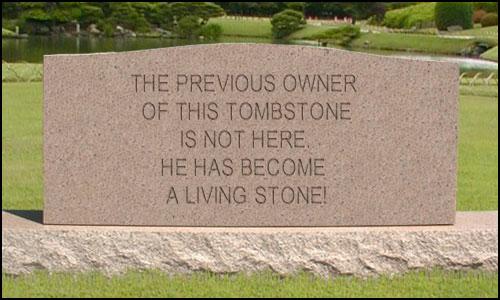
Are You a Tombstone or a Living Stone? A Homily for the 5th Sunday of Easter

By His resurrection, Jesus has brought us from death to life. He has snatched us from this present evil age (Gal 1:4) and from the death-directed desires of our body (Rom 6:12), and made us into a new and living creation (2 Cor 5:17). As such, we have exchanged the tombstones that once indicated we were dead in our sins and have become living stones in the spiritual edifice that is the Body of Christ and also the Church.

In the Epistle for today’s Mass (1 Peter 2:4-9), we are summoned to this new life and told what some of its characteristics are. Let’s take a look at how we go from being tombstones to living stones by considering this text in three sections.

1. The Call of Salvation Come to him, a living stone, rejected by human beings but chosen and precious in the sight of God, and, like living stones, let yourselves be built into a spiritual house.

Notice first the invitation that is made: Come to Him! Let yourself be built! The entire Christian life is based on our response to an invitation to accept Jesus Christ and to let Him transform our life. We are to say, “yes,” not only to Jesus, but also to what He can do for us. He will take our broken, crumbling lives and rebuild them. In what sense will He do this? Two images are offered:

Living Stones A stone is an odd image for life. There doesn’t seem to be anything less living than a stone! What does it mean to be a “living stone”? First, it means to be alive, to be full of life! Second, it means that some of the better qualities of stone are to be ours. A stone is firm, weighty, not easily moved, and able to withstand a heavy load. Thus we too are to be strong and firm in our faith, not easily moved about by the currents of the world or tossed to and fro by the waves and carried about by every wind of doctrine, by human cunning, by craftiness in deceitful schemes (Eph 4:14). Stable and firm, we are also able to carry the weight and bear the difficulties imposed by this world. We are able to support and carry others in their time of need, sharing their burdens. Yes, living stones—strong, firm, not easily moved, and alive, quite alive!

A Spiritual House – The image implies that in a spiritual sense, we as living stones make up the walls of the Church. We are fitted together like stones into a wall that is strong and sure. We are not saved merely unto ourselves, but also for the sake of others. By God’s grace, we depend upon one another, each of us carrying his share of the burden. Each stone in the wall does its part. Remove one stone and the whole wall is weakened. Only together is the wall solid and sure.

2. The Choice for Salvation whoever believes in it shall not be put to shame. Therefore, its value is for you who have faith, but for those without faith: The stone that the builders rejected has become the cornerstone, and a stone that will make people stumble, and a rock that will make them fall. They stumble by disobeying the word, as is their destiny.

Simply put, we have a choice to make. That choice will determine if Jesus is the cornerstone who supports us or a stumbling block over which we trip and fall. It is an interesting phenomenon that when a person is being rescued at sea, sometimes the victim will reach out and grab the life ring that is tossed to them, while others will resist attempts to save them, seeing it as something that will further endanger them.

What is meant by the “cornerstone”? It usually brings to mind a ceremonial stone with an inscription and possibly some historical things embedded. Here, though, it refers more to the stone at the bottom of an arch or the row of bricks that supports the whole arch. It had to be a very carefully crafted stone since all the other stones depended on its integrity and perfect shape to support them. This is Jesus Christ for us. We are all leaning on Him; He is the perfect stone who carries our weight.

But for those who reject Christ, He is a stone over which they trip and fall. Surely Jesus wants to save us all, but some reject Him and for them He becomes a stumbling block. We cannot remain neutral about Jesus. We must decide one way or the other about Him: yes means salvation; no means condemnation. He will either be a cornerstone or a stumbling block; there is no third way. To those who knowingly reject Him, He is a stumbling block. This image also explains some of the venomous attacks on Christ and Christianity from the world. When one trips over something and falls, one tends to curse what caused the fall.

The choice is ours. May it be Christ and may He be our cornerstone—the only One on whom we can lean and rely with certainty. Only this will take us from being tombstones to living stones.

3. The Characteristics of Salvation – You are a chosen race, a royal priesthood, a holy nation, a people of his own, so that you may announce the praises of him who called you out of darkness into his wonderful light.

Notice four characteristics of those who are no longer tombstones, but are living stones:

Our Pedigree – The text calls us a “chosen race.” We’ve reflected on making Christ our choice, but here we are reminded that before we chose Him, He chose us. If we received an invitation to the White House, many of us would feel that we had “made it” and would proudly tell our friends of the great honor. Yet we take little notice that we are chosen by God and invited to the great Wedding Feast of the Lamb. Yes, we are chosen; we have a pedigree. We are of the household of God. This is greater than any worldly dignity and it is able to overcome any indignity that the world heaps upon us.

Our Priesthood – Each of us who is baptized into Christ Jesus is made priest, prophet, and king. This “royal” priesthood, while different from the ministerial priesthood, has this similarity: every priest is enabled to offer a sacrifice pleasing to God. In the Old Testament, priests offered up something distinct from them, usually an animal. But in the priesthood of Jesus Christ, the priest and the victim are one and the same. Jesus offered Himself. All of the baptized are equipped by God to offer the pleasing sacrifice of their very selves to God. Here is a very great dignity given to us by Jesus: to have a perfect right to stand in His Father’s presence, praise Him, and offer a fitting sacrifice. Only ministerial priests of the Church can bring us the sacraments, but all baptized believers share in the royal priesthood, wherein they freely offer themselves to God.

Our Place – The text calls us a “holy nation.” To be holy means to be set apart. Hence we are called out from among the many to be a people that is set apart for God. While all are invited to Christ, only those who accept the invitation receive the grace to be called a holy nation. As such, we should understand that our role is not to “fit in” with this sin-soaked world, but rather to stand apart from it, to be recognizably distinct from it. Our behavior, priorities, love, joy, and charity should be obvious to all. To be a holy nation is a great honor, but also a great responsibility. May this curse of Scripture never be said about us: As it is written: “God’s name is blasphemed among the Gentiles because of you” (Rom 2:24).

Our Proclamation – The text says that the Lord has acted in our life so that you may announce the praises of him, who called you out of darkness into his own, wonderful light. Yes, the Lord has been good to us and is changing our lives! If you are faithful, then you know what He has done for you and you have a testimony to give. Scripture says that we were made for the praise of his glory (Eph 1:6). Do people hear you praise the Lord? Have you glorified His name among the Gentiles? (Rom 15:9) Do people know of your gratitude? Have they heard of your witness to the Lord? Can you articulate how God has called you out of darkness into His marvelous light? You ought to be a witness for the Lord! This is a necessary characteristic of those who are no longer tombstones, but living stones.

Are you a tombstone or a living stone?